Publications
Each entry links to the paper and, where one exists, to the model code on ModelDB. Also on Google Scholar and ORCID.
Journal articles
-
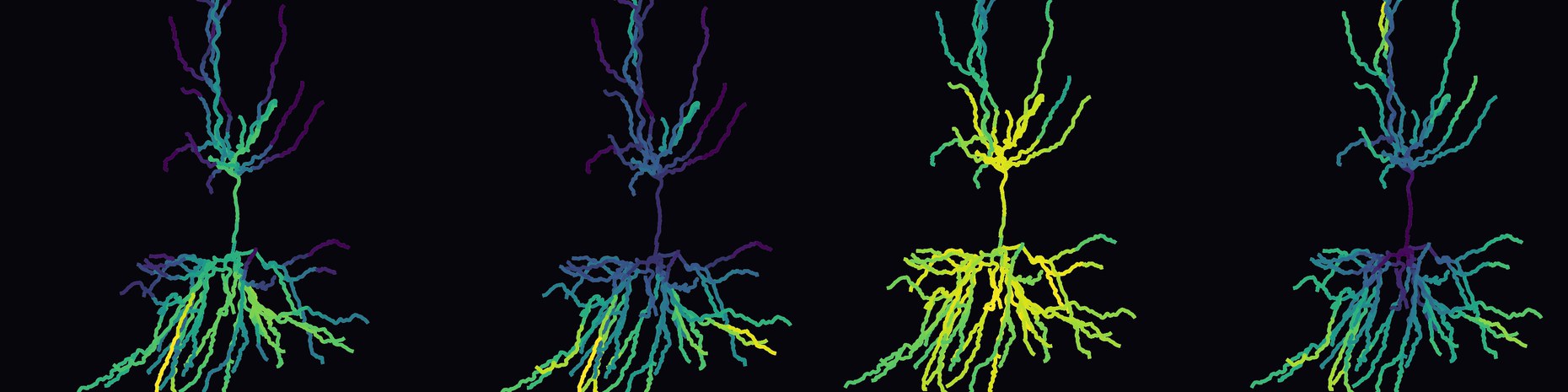
Computer models predict differential dendritic vulnerability with ischemia and spreading depression
2026PLOS Computational Biology 22, e1014701
In a morphologically detailed model of a hippocampal CA1 pyramidal neuron, calcium accumulates most in the basal dendrites during both ischemia and spreading depolarization, suggesting they are most exposed to excitotoxicity. Only ischemia exposes the distal apical dendrites to high chloride, a possible route to dendritic beading.
PaperModel on ModelDB -
Capillary Density and Neuronal Homeostasis in Human Primary Visual Cortex
2026Microcirculation 33, e70064
Measures the distance between more than 155,000 neurons and 84,000 vascular profiles across the layers of human primary visual cortex. Neurons in the middle layers sit closest to capillaries. These measurements set where capillaries sit in our cortical models of spreading depolarization.
Paper -
Biophysical modelling of intrinsic cardiac nervous system neuronal electrophysiology based on single‐cell transcriptomics
2025Journal of Physiology 603, 2119–2138
A library of electrophysiological models of neurons in the heart's intrinsic cardiac nervous system, each built from the ion channels found in single-cell transcriptomic data. Like the real neurons, most models fire phasically.
Paper -
Downmodulation of Potassium Conductances Induces Epileptic Seizures in Cortical Network Models Via Multiple Synergistic Factors
2025Journal of Neuroscience 45, e1909232025
Cortical network models with potassium diffusion and glial buffering show how reducing voltage-gated K+ conductance, as 4-aminopyridine does, broadens action potentials, drives fast-spiking interneurons into depolarization block and produces seizure-like synchrony.
PaperModel on ModelDB -
Unpacking the multimodal, multi‐scale data of the fast and slow lanes of the cardiac vagus through computational modelling
2024Experimental Physiology 109, 1994–2000
A review setting out how computational models can integrate molecular, cellular and physiological data on the fast and slow vagal pathways that regulate the heart.
Paper -
A pipeline for the retrieval and extraction of domain-specific information with application to COVID-19 immune signatures
2023BMC Bioinformatics 24, 292
A classifier built on document embeddings, trained iteratively with expert review, finds papers reporting human COVID-19 immune signatures with an 86% positive predictive value; a semi-automated system then asks the authors for the signatures.
Paper -
Multiscale Computer Modeling of Spreading Depolarization in Brain Slices
2022eNeuro 9, ENEURO.0082-22.2022
A model of 36,000 neurons in the extracellular space of a brain slice, with K+, Na+, Cl− and O2 diffusion, reproduces spreading depolarization at realistic speeds and predicts that extracellular volume, neuronal density and oxygenation control its spread.
PaperModel on ModelDB -
Conditions for Synaptic Specificity during the Maintenance Phase of Synaptic Plasticity
2022eNeuro 9, ENEURO.0064-22.2022
Analysis and reaction-diffusion simulations in NEURON show that synapse-specific maintenance of plasticity requires the molecular switch, such as PKMζ, to reside in dendritic spines, which sets strict limits on protein diffusion, turnover and spine shape.
PaperModel on ModelDB -
Modernizing the NEURON Simulator for Sustainability, Portability, and Performance
2022Frontiers in Neuroinformatics 16, 884046
How NEURON was modernized: continuous integration, a new build and release workflow, GPU support through CoreNEURON and the NMODL compiler, and Just-In-Time compilation that speeds up reaction-diffusion simulations.
Paper -
Efficient Simulation of 3D Reaction-Diffusion in Models of Neurons and Networks
2022Frontiers in Neuroinformatics 16, 847108
A finite-volume method in NEURON for 3D intracellular reaction-diffusion, coupled to NEURON's 1D electrophysiology. It captures dynamics in spines and near the soma that 1D simulations miss.
PaperModel on ModelDB -
Neuron Names: A Gene- and Property-Based Name Format, With Special Reference to Cortical Neurons
2019Frontiers in Neuroanatomy 13, 25
A naming format for neuron types that carries gene expression and functional properties alongside anatomical location, with examples from mouse cortex.
Paper -
Using NEURON for Reaction-Diffusion Modeling of Extracellular Dynamics
2018Frontiers in Neuroinformatics 12, 41
Introduces extracellular reaction-diffusion in NEURON. Tissue is described by its free volume fraction and tortuosity, so models can include regional differences and pathology; illustrated with spreading depression.
PaperModel on ModelDB -
Modeling microelectrode biosensors: free-flow calibration can substantially underestimate tissue concentrations
2017Journal of Neurophysiology 117, 937–949
Modeling and experiments show that microelectrode biosensors calibrated in free flow underestimate concentrations in tissue: the sensor consumes the analyte it measures, creating a depletion gradient that tissue porosity and tortuosity make worse.
Paper -
Computer modeling of ischemic stroke
2016Drug Discovery Today: Disease Models 19, 77–83
A review of multiscale computer modeling of ischemic stroke, from molecules to tissue, as a route to multi-target neuroprotective therapies.
Paper
Book chapters
-
Brain Ischemia and Stroke
2022In: Jaeger D, Jung R (eds), Encyclopedia of Computational Neuroscience. Springer, pp. 562–569
Encyclopedia entry on modeling cerebral ischemia, from the loss of oxygen and glucose supply to the many pathways of cell death across spatial and temporal scales.
Paper -
Modeling of Disease: Physical and Molecular Level, Overview
2022In: Jaeger D, Jung R (eds), Encyclopedia of Computational Neuroscience. Springer, pp. 77–81
Overview of the encyclopedia section on physical- and molecular-scale models of disease and their place in translating basic research to the clinic.
Paper -
Computational Neuroscience of Neuronal Networks
2022In: Pfaff DW, Volkow ND, Rubenstein JL (eds), Neuroscience in the 21st Century. Springer, pp. 3421–3459
An introduction to modeling networks of tens to millions of neurons, and to deciding what to simplify when crossing spatial and temporal scales.
Paper -
Computational Neuroscience of Synapses and Neurons
2022In: Pfaff DW, Volkow ND, Rubenstein JL (eds), Neuroscience in the 21st Century. Springer, pp. 3381–3410
An introduction to simulating neurons and synapses, from the membrane as a capacitor and resistor to multicompartment models.
Paper
Thesis
-
Modelling adenosine dynamics in neural tissues
2015PhD thesis, University of Warwick
A macroscopic model of adenosine clearance in neural tissue, built from the literature and validated against experiments.